Modern Slavery
Modern Slavery and Human Trafficking Statement (FY2025) (issued pursuant to section 54 of the Modern Slavery Act 2015)
Our business and operations
Global Switch is a leading owner, operator and developer of large scale, carrier and cloud-neutral, multi-customer data centre facilities across Europe and the Asia-Pacific region.
Our business centres on the provision of highly resilient, secure and energy-intensive technical environments in global financial hubs, enabling customers to house critical IT infrastructure. The vast majority of our workforce is engaged in the delivery, management and operation of our data centres. We do not own or operate manufacturing facilities or construction companies, but we rely on a global network of suppliers and contractors to support our operations and development activities.
Global Switch recognises its responsibility to respect human rights across its activities and business relationships and is committed to preventing modern slavery, servitude, forced or compulsory labour, and human trafficking in any form.
Our commitment and governance framework
Global Switch has a zero-tolerance approach to modern slavery and human trafficking. We are committed to acting ethically, responsibly and transparently throughout our business and supply chain, and to complying with the UK Modern Slavery Act 2015 and all applicable local legislation.
Our approach is anchored in our Code of Conduct and Anti-slavery and Human Trafficking Policy, both being reinforced by our Supplier Code of Conduct which sets out the standards we expect of our suppliers and business partners. These policies are supported by group-wide recruitment controls, centrally overseen by our Human Resources function, to ensure fair treatment, lawful working practices, and compliance with employment and labour standards.
As published in our 2024 ESG Report, the Global Switch Board has ratified our business human rights commitments. These commitments apply across our operations and value chain and are aligned with recognised international standards, including the International Bill of Human Rights, the OECD Guidelines for Responsible Business Conduct, the UN Guiding Principles on Business and Human Rights, and relevant International Labour Organization conventions.
Oversight of modern slavery risk forms part of our wider sustainability and human rights governance framework, with engagement across Legal, Human Resources, Procurement, Sustainability and senior management.
Policies and standards
Our Code of Conduct and Anti-slavery and Human Trafficking Policy establish clear expectations around ethical behaviour, workplace rights, freedom of association, non-discrimination, fair treatment, and the prevention of any form of human-rights abuse.
In 2024, we implemented a formal Supplier Code of Conduct. This requires suppliers to:
· comply with all applicable anti-slavery, human trafficking and child-labour laws;
· maintain appropriate policies and controls to prevent modern slavery within their own operations and supply chains;
· conduct due diligence proportionate to their risk profile;
· ensure workers are treated lawfully, ethically and with dignity; and
· provide appropriate training to personnel delivering services to Global Switch.
Global Switch reserves the right to audit suppliers’ compliance with these requirements and to require remediation where deficiencies are identified. Failure to meet these expectations may result in corrective action, up to and including termination of the business relationship.
Due diligence and controls
Our Sustainability and Human Rights Due Diligence framework is informed by the OECD due diligence model and focuses on identifying, preventing, mitigating and, where appropriate, remediating adverse human-rights impacts.
Key elements of our approach include:
· Risk-based supplier engagement, focused on sectors where labour-intensive activity is prevalent.
· Contractual and policy controls, including the integration of our Supplier Code of Conduct into supplier relationships.
Whistleblowing and grievance mechanisms, enabling confidential reporting of concerns relating to modern slavery or unethical practices.
As Global Switch expands into new regions, our due-diligence framework is being further developed to reflect local risk factors and regulatory expectations. This includes prioritising pre-engagement risk assessments for suppliers operating in higher-risk sectors or jurisdictions, strengthening audit and monitoring rights, and increasing collaboration between Procurement, Legal, Sustainability and project teams to ensure modern-slavery risks are identified and managed at the earliest stages of project development.
Global Switch maintains a dedicated whistleblowing channel (whistleblowing@globalswitch.com), available 24/7 to employees, suppliers and external stakeholders. Reports are routed through an independent provider (www.safecall.co.uk/file-a-report/) and may be made in any language. Information on this reporting channel is published in our Code of Conduct, Whistleblowing Policy, Employee Handbook, Grievance Policy and Supplier Code of Conduct
Supply chain profile and risk assessment
Our supply chain primarily comprises equipment manufacturers, construction and engineering contractors, and professional and operational service providers supporting our data centre operations and development activities.
We consider our overall inherent risk exposure to be lower than in many labour-intensive industries, given the technically specialised nature of much of our supply base and the jurisdictions in which we primarily operate. However, we recognise that construction, facilities management, engineering and security services can present elevated labour-rights risks and require particular attention.
In 2025, Global Switch undertook an ESG risk and certification review of its top 100 suppliers, representing approximately 86% of total supplier spend. Suppliers were categorised by service type and risk exposure. As part of this assessment:
· 64% of supplier spend within labour rights risk categories was with suppliers holding a formal human-rights policy or certification; and
· 85% of that spend was with suppliers certified to ISO 45001, reflecting established occupational health and safety management systems.
We recognise that the expansion of our development and operational footprint into new jurisdictions, including South-East Asia, may introduce different regulatory environments, labour practices and risk profiles. In particular, as we progress developments in locations such as Thailand and Malaysia, we acknowledge the importance of heightened vigilance in relation to labour standards and workforce protections within construction, engineering and facilities-management supply chains.
In response, Global Switch is intending to strengthen its supplier-due-diligence approach to ensure that enhanced, risk-based assessments are embedded into procurement and onboarding processes for new projects and new markets. This includes the integration of human-rights and modern-slavery screening, contractual controls and supplier engagement as part of our expansion strategy.
Effectiveness and performance indicators
During FY2025, there were no substantiated human-rights or modern slavery incidents reported within Global Switch’s operations or through our whistleblowing channels.
We continue to review the effectiveness of our controls and data collection processes and to strengthen our ability to identify, monitor and respond to potential modern slavery risks across our value chain.
Training and awareness
Global Switch provides mandatory internal training to 100% of its employees on modern slavery and human trafficking. This training is designed to increase awareness, support early identification of risk indicators, and ensure employees understand how to raise concerns appropriately.
Our Code of Conduct and related policies reinforce these expectations and are supported by ongoing internal communications.
Ongoing commitment
Global Switch is fully committed to supporting the eradication of modern slavery and human trafficking. We will continue to monitor our operations and supply chains, strengthen our due-diligence processes, and enhance supplier engagement as our business evolves and expands into new regions.
Approval
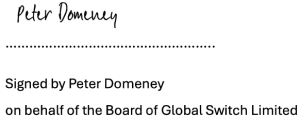
This statement is made pursuant to section 54 of the Modern Slavery Act 2015 and has been approved by the Board of Directors of Global Switch.